
Recently, the research team led by Dr. Lü Song, a young faculty member at the School of Naval Architecture, Ocean and Energy Power Engineering of Wuhan University of Technology (WUT), reported new progress in high-strength thermochromic solar spectrum regulation. Their study, entitled “Thermochromic Hydrogels for Synergistic Mechano-Optical Properties for Global Energy-Saving Potential”, was published in Nature Communications, a sub-journal of Nature. WUT is listed as the sole institutional affiliation of the paper. Master’s student Yang Bowen is the first author, and Dr. Lü Song serves as the corresponding author.
With global energy consumption and carbon emissions continuing to rise, improving energy efficiency and increasing the utilization of renewable energy have become essential pathways toward achieving carbon neutrality. As the primary channel for energy exchange, windows are also the main source of energy loss and unwanted heat gain. In the context of intensifying heating and cooling demands, research and application of adaptive solar spectrum modulation technologies have become particularly important.
Solar spectrum modulation techniques generally include photochromic, electrochromic, and thermochromic approaches. The first two face limitations such as complex fabrication, high energy consumption, and high cost. In contrast, thermochromic materials automatically adjust their transparency in response to ambient temperature without requiring external energy input. Their merits—including self-adaptivity, zero energy consumption, simple preparation, and low cost—make them promising candidates for renewable energy utilization and energy-saving applications.
Among various thermochromic materials, hydrogels have drawn considerable attention due to their phase-transition temperatures near room temperature, straightforward fabrication, good flexibility, environmental friendliness, and low cost. Hydrogels allow high visible transmittance at low temperatures for natural lighting, while effectively blocking solar radiation at high temperatures to achieve dynamic energy savings. However, conventional hydrogels often suffer from inadequate adhesion, low tensile strength, and a low elastic modulus, leading to structural instability and interfacial failure during long-term use. Although increasing crosslinking density, introducing reinforcement components, or adjusting water content can improve mechanical properties, such modifications often compromise transmittance or solar modulation capability, resulting in performance coupling constraints. Achieving synergistic optimization of optical, thermal, and mechanical properties remains a central scientific challenge in the development of high-performance thermochromic solar modulation materials.
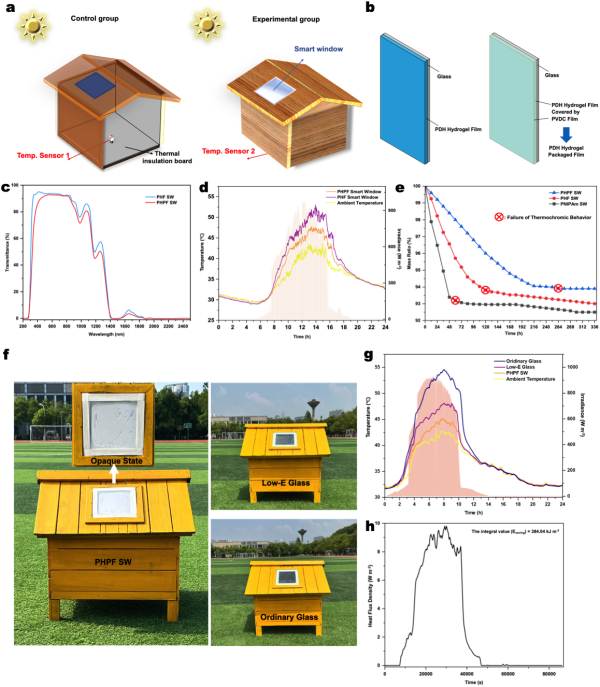
To address this issue, Lü and his team designed and synthesized a thermo-responsive hydrogel (PDH hydrogel) with a composite crosslinked network structure, prepared through free-radical polymerization of N-isopropylacrylamide (NIPAm), N,N-dimethylacrylamide (DMAA), and 2-hydroxyethyl acrylate (HEA). The hydrogel exhibits remarkable breakthroughs in both optical and mechanical properties, including high visible transmittance (T_lum = 97.92%), strong solar modulation capability (ΔT_sol = 81.70%), and excellent mechanical strength (adhesion strength: 54.63 kPa; tensile strength: 34.31 kPa; elastic modulus: ~129.35 kPa). These results demonstrate successful synergistic enhancement across multiple key performance dimensions.
Practical tests further show that compared with commercial Low-E glass and standard glass, PDH adaptive windows can reduce average indoor daytime temperatures by 6.95 °C, achieving daily energy savings of 384.04 kJ m⁻², highlighting their exceptional energy-saving potential and application prospects. Building upon these findings, Lü and his team integrated global climate datasets to establish a predictive global Energy-Saving and Carbon-Reduction (ESCR) model for PDH hydrogel–based systems, providing scientific guidance for its deployment across different regions.
This adaptive spectral modulation technology holds promise for applications in marine vessels, automobiles, buildings, and industrial manufacturing. The research not only offers new insights into the synergistic design of solar spectrum modulation and mechanical strength, but also lays an important foundation for its global implementation.
Paper link: https://www.nature.com/articles/s41467-025-65071-w
Rewritten by: Liang Muwei
Edited by: Li Huihui, Li Tiantian
Source: School of Naval Architecture, Ocean and Energy Power Engineering
|
|