
Recently, the research team led by Professor He Daping at Wuhan University of Technology (WUT) has made an innovative breakthrough in the electromagnetic interference (EMI) shielding manipulation of graphene-film metamaterials. The study extends classical electromagnetic equivalent circuit theory, traditionally applied to metallic materials, to advanced carbon materials with microstructured architectures, and on this basis develops a series of graphene-film-based metamaterials with outstanding EMI shielding and modulation performance. The related research, titled “Polarization manipulation of electromagnetic interference shielding effectiveness utilizing graphene film-based metamaterials”, was published in Nature Communications. The first author is Dr. Wang Zhe, a postdoctoral researcher at the State Key Laboratory of Advanced Technology for Materials Synthesis and Processing. The corresponding authors are Professor Zu Haoran from the School of Information Engineering, Professor Li Shuxin from the State Key Laboratory of Advanced Technology for Materials Synthesis and Processing, and Professor He Daping from the School of Physics and Mechanics.
Building on the team’s prior work on laser-induced graphene electromagnetic metasurfaces and oriented carbon-fiber-based electromagnetic control materials (National Science Review, 2025, 12(11): nwaf395; Small, 2025, 21(16): 2408366), the researchers innovatively developed a highly conductive graphene film metamaterial (GAFM) capable of polarization-dependent manipulation of EMI shielding effectiveness. By generalizing equivalent-circuit concepts to carbon-based materials, the system enables continuous switching between “on” and “off” states through simple rotational operations (Fig. 1). To further broaden the controllable range of EMI shielding effectiveness (ΔEMI SE), carbon fibers (CF) were composited with the GAFM. Two configurations—parallel and perpendicular alignment—were employed to realize enhanced polarization contrast and omnipolarized shielding, respectively. By extending classical electromagnetic equivalent circuit theory from conventional metals to microstructured advanced carbon materials (Fig. 2), the study not only elucidates the mechanisms and polarization-control principles of EMI shielding in advanced carbon systems, but also achieves the widest polarization-contrast control range to date (polarization sensitivity enhanced to 1061.60 dB/mm), the highest omnipolarized shielding efficiency (exceeding 99.15%), and a remarkably broad state-switching efficiency range (3.17%–99.79%). These findings provide new insights into the dynamic control of electromagnetic responses and lay a solid foundation for the development of intelligent EMI shielding materials, addressing the needs of complex high-fidelity electromagnetic protection systems, adaptive camouflage devices, and future smart living environments.
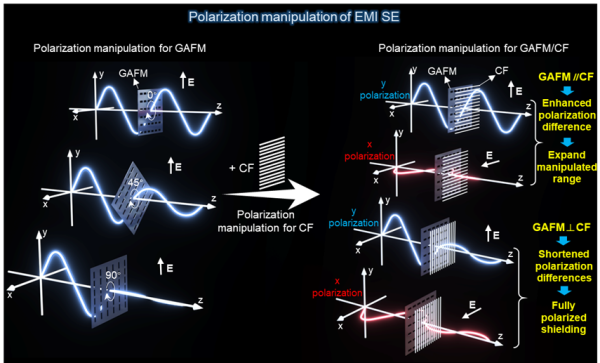
Figure1 Schematic illustration of the graphene film–based metamaterial (GAFM) for polarization manipulation of electromagnetic interference (EMI) shielding and its composite design with carbon fibers (CF)
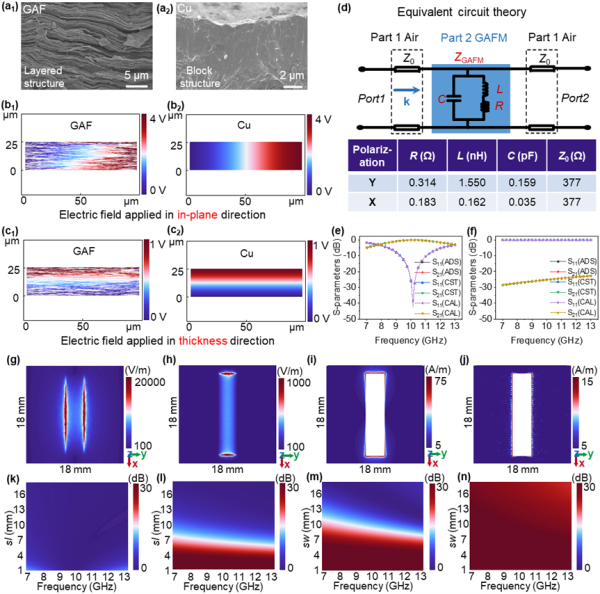
Figure2 From the microstructural structure–function relationship of GAFM to its macroscopic equivalent circuit and corresponding macroscopic electromagnetic response
Paper Link: https://doi.org/10.1038/s41467-025-67335-x
Written by: Wang Zhe
Rewritten by: Liang Muwei
Edited by: Li Huihui, Li Tiantian
Source: School of Physics Mechanics
|
|