
On March 31, the CCTV News Channel program “24 Hours · Meeting You” featured a report titled “Liu Yiwen: Establishing the ‘Letters Home’ Radio in the Strait of Hormuz”. The story highlighted Liu Yiwen, a 2018 alumnus of Wuhan University of Technology (WUT) and an ocean-going seafarer, who set up the “Letters Home” radio to help numerous stranded and uncontactable compatriots send messages to their families, sharing a touching story of reassurance and connection.
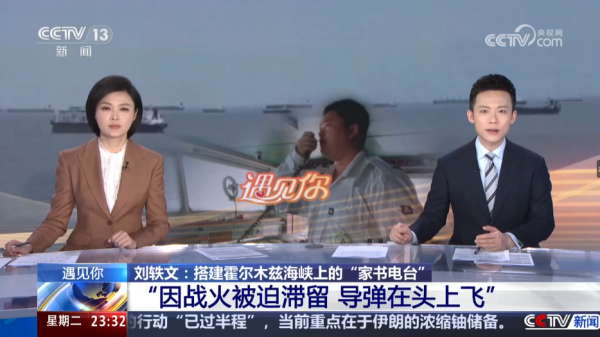
The report noted that the situation in the Strait of Hormuz has remained tense recently, with multiple vessels stranded in nearby waters. Internet and communication signals on some ships were interrupted, leaving crew members unable to contact the outside world. Liu Yiwen, a crew member from Jilin Province, is currently stranded near the Strait of Hormuz. Fortunately, he can still communicate with the outside world. Using the ship’s public radio frequency, he set up a temporary “Letters Home” radio station. On one end of the radio waves were seafarers cut off from their families; on the other end were families filled with anxious concern. A single message of safety from both sides, spanning vast oceans, not only addressed the urgent need but also became the most comforting force during this difficult time.
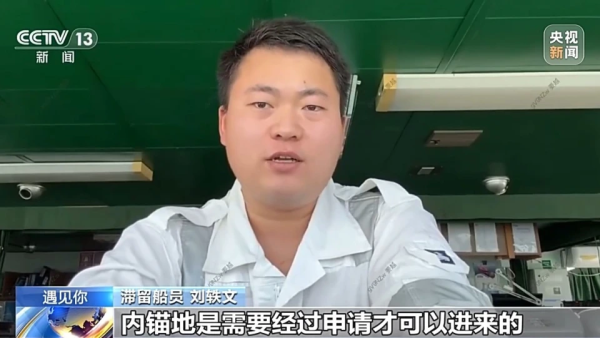
Liu Yiwen said, “My ship is currently located at Khor Fakkan port in the UAE, in waters outside the Strait of Hormuz. There are a great many ships anchored nearby. You can look in the direction I’m pointing. Do you see the white smoke? That’s from the port I saw being attacked earlier.”
Liu Yiwen explained the local situation while filming with his phone. Originally, ships should maintain a safe distance of 0.5 nautical miles between each other, but now it has been reduced to about 0.3 nautical miles.
“This area belongs to the inner anchorage of Khor Fakkan port, which requires an application to enter. There are even more ships in the outer anchorage, but they have little security because it’s very difficult for them to receive supplies, provisions, and fresh water.”
Before the conflict erupted, the Panamanian-flagged liquefied petroleum gas (LPG) carrier that Liu Yiwen was on had already arrived at the anchorage of Khor Fakkan port to complete customs clearance procedures and take on supplies and provisions. After resting, they were supposed to pass through the Strait of Hormuz and enter the Persian Gulf to load liquefied petroleum gas. But no one expected that war would break out so suddenly. The ship came to a halt, with the chaos of war raging not far away. Liu Yiwen’s ship was very close to the shore, and the roar of explosions was as clear as if they were right beside them.
After graduating from the School of Navigation at Wuhan University of Technology, Liu Yiwen has been working in maritime navigation on ocean-going cargo ships for eight years. He spends half of each year on board and the other half resting at home. He said this isn’t the first time he has encountered warfare.
Liu said, “When it first broke out, we thought the war might be similar to previous ones and end quickly, but in reality, it seems to have intensified. We often see missiles flying overhead, and the pressure we bear is immense.”
With the flames of war so close, Liu Yiwen hasn’t had a proper night’s sleep since. Fortunately, their ship had just been resupplied with provisions and can produce fresh water. The current supplies are enough to last for about a month and a half. Moreover, his location is close to the shore, allowing him to use satellite communication. Although the signal isn’t very stable, he can connect to the internet and stay in touch with the outside world. Liu Yiwen contacted his family as soon as possible to let them know he was safe. Liu Yiwen is fortunate because his ship can communicate with the outside world, allowing him to reassure his family. However, many other ships closer to the Strait of Hormuz are cut off from the internet and can only use the Very High Frequency (VHF) public communication radio to communicate with other vessels within effective range. On March 2, the third day after the conflict erupted, Liu Yiwen was, as usual, stationed by the communication equipment. Suddenly, he heard a sailor speaking with a Hebei accent asking for updates over the VHF radio.
Liu noted, “Every deck officer on duty monitors Channel 16, where we exchange information daily. That day, I heard a ship asking, ‘Do you have internet on your vessel?’ The reply was, ‘Our ship’s internet has been blocked. We haven’t been able to contact our families for days.’ The voice was very low and sounded deeply sad. I immediately asked if the ship needed help. Later, I had them switch to a semi-public channel and told them I could add their wife on WeChat to let her know they were safe.”
Just like that, Liu Yiwen added the sailor’s wife on WeChat using the contact details provided over the radio. While keeping in touch with the sailor on the semi-public channel, he simultaneously messaged the sailor’s wife on his phone. From then on, Liu Yiwen paid extra attention to calls for help from Chinese crew members over the radio and eventually helped six sailors get in touch with their families.
“During my shifts, I broadcast over the VHF every hour or two, asking if anyone was without internet or needed help, and telling them to call out over the radio if so. It was almost a reflex. If I knew someone couldn’t get in touch and I had the means and ability to help, I would. Especially out at sea, there aren’t many Chinese around. When you do come across someone who speaks Chinese, it feels particularly heartwarming, almost like family. If you can help, you just do.”
Most of the time, after Liu Yiwen’s broadcasts, there was only silence in response. Most of the sailors he had helped reassure their families have also lost contact. He can only guess that some ships may have left the area, or that more sailors have since managed to contact their families. To this day, some family members of sailors, after briefly hearing their loved ones’ voices but still unable to maintain contact, occasionally send Liu Yiwen messages on WeChat. Liu Yiwen shares updates about the situation on the surrounding waters, hoping to offer them a little peace of mind.
Liu Yiwen is a member of the “post-1995” generation. After graduating from WUT in 2018, he began his career as a seafarer, alternating between six months at sea and six months on shore leave. Over eight years of ocean voyages, he has risen from a cadet to a second officer and trainee chief officer. On board, his main responsibilities include navigation and berth watch duties. When asked about his recent wish, he said he hopes the war ends soon so he can return home early.
In the evening, Liu Yiwen’s wife, Li Ling, and his father tried to video call him. Due to unstable signal at sea and the time difference, the call did not go through. Li Ling and Liu Yiwen have known and been in love for almost eight years. This is not the longest time Liu Yiwen has been at sea, but it is the most worrying for Li Ling.
Liu Yiwen’s wife, Li Ling said, “On average, I’d say about six months or more. The longest he was away was 12 months and 9 days. Once, we completely lost contact for 7 days. In a war situation like this, everyone is naturally even more anxious.”
When Li Ling learned that her husband had helped many sailors get in touch with their families, she said she was happy but not surprised by his act of kindness, “I’m very happy. It’s very much in line with his usual behavior.”
Li Ling once wrote a letter to Liu Yiwen titled “A Letter from Home Is Worth Ten Thousand Pieces of Gold.” Between the lines were full of longing and hope. “The vast sea is too expansive; sometimes I can’t even hear your ‘hello’ clearly. But for our future, we are both striving.”
CCTV Reporter asked him, “After this mission is over, will you continue to go to sea?”
Liu Yiwen responded, “Yes. I am very passionate about navigation. I find great meaning in doing this work.”
In the letter Li Ling once wrote to Liu Yiwen, “When facing any difficulty or setback, don’t panic. Staying steady is how we grow up.” “Please remember, you have the sea and distant horizons in your heart, and I have you in mine. No matter how high or far you fly, there will always be a lighthouse in your home in the East, guiding your way.”
When the families of the sailors finally heard their husbands’ voices over Liu Yiwen’s frequency, history and the present, the strait and home, were all tightly connected through the ancient line, “For three months the beacon fires soar and burn; a word from home is worth ten thousand gold in truth.” As missiles streaked overhead and the flames of war burned close by, receiving help from a fellow countryman and managing to contact their families was, for any stranded sailor, an immense comfort.
As the song says, “The home is the smallest nation, the nation is the largest home.” The lighthouse in Li Ling’s letter is both their small home and the larger home that is the nation. What awaits all sailors’ safe return is not only their individual small homes but also the greater home that is the nation. We sincerely hope that this temporary “Letters Home” radio in the Strait of Hormuz will soon fulfill its mission and cease operation, and that all stranded sailors may return home safely at the earliest.
Rewritten by: Li Huihui
Edited by: Mei Mengqi, Li Tiantian
Source: CCTV News Channel
|
|