
Recently, the research team led by Academician Zhang Lianmeng has made significant progress in the passivation of copper-based materials. Relevant findings, entitled “Anodic Coordination Polymerization for Bilayer Passivation of Copper against Oxidation”, were published in Nature Communications. The researchers Peng Jian and Zhang Song from the State Key Laboratory of Advanced Technology for Materials Synthesis and Processing, along with Professor Zhao Yun from South China University of Technology, are co-corresponding authors. Doctoral students She Xiaomeng and Yang Huayue, and assistant researcher Zhang Chi are the co-first authors. Wuhan University of Technology (WUT) is the first affiliation.
Copper is a fundamental material in modern electronic devices and energy systems. Against the backdrop of the rapid development of high-techs, including AI, high-performance computing, and 5th-generation mobile communication technology, copper’s reliability and long-term durability have attracted considerable attention from researchers. However, copper is highly susceptible to electrochemical corrosion when exposed to ambient moisture and salty conditions, and it fails to form a dense, stable self-passivation layer. It has been a long-standing core issue in this field to achieve long-term and efficient protection of copper without sacrificing its exceptional electrical conductivity.
To address these challenges, the research team innovatively proposes an anodic oxidation-induced coordination polymerization strategy, in which copper ions are released and in situ coordinated with 1,4-benzenedithiol (BDT) molecules to construct a dense nanoscale protective film under electrochemical conditions. This structure establishes a compositional and density gradient, provides higher interfacial stability, and reduces interfacial defects.
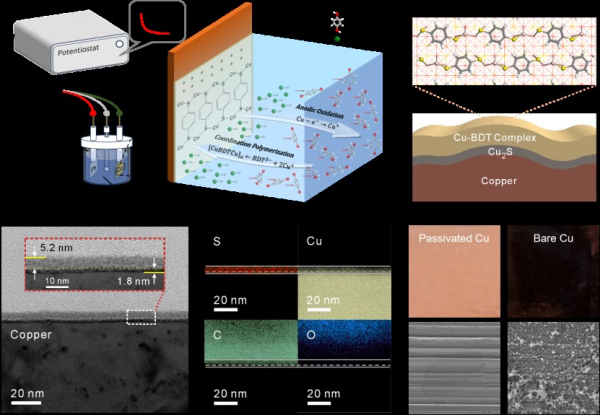
This passivation film delivers outstanding corrosion resistance and exceptional environmental stability, hardly affecting the electrical conductivity of copper substrates. Density Functional Theory (DFT) calculations further demonstrate that the passivation layer remarkably increases the adsorption energy barriers of corrosive species, including O2 and Cl- on the copper surface, thus reducing corrosion at the atomic scale.
Furthermore, this passivation strategy is successfully integrated into a roll-to-roll processing system, achieving stabilization treatment of large-scale copper foil and demonstrating its potential for scalable application. The anodic oxidation-induced coordination polymerization strategy introduced in this study provides a brand-new pathway to construct a metal-protective layer at the molecular scale. It also offers crucial technical support for high-reliability electronic devices, energy systems, and the long-term stable operation of metal materials in extreme environments facing the AI era.
Paper link: https://www.nature.com/articles/s41467-026-72231-z
Written by: Peng Jian
Rewritten by: Mei Mengqi
Edited by: Li Huihui, Li Tiantian
Source: Institute of New Materials
|
|