
Recently, Academician Cheng Yibing’s team from Wuhan University of Technology (WUT), together with Foshan Xianhu Laboratory and other partners, achieved major original breakthroughs in key perovskite thin-film photovoltaic technologies. Two studies were published in Nature Energy and Nature Communications, tackling the industry bottlenecks of strain-induced distortion and phase heterogeneity in multicomponent perovskite films, offering new pathways for industrializing efficient and stable next-generation perovskite photovoltaics. The State Key Laboratory of Advanced Technology for Materials Synthesis and Processing at our university is the first corresponding institution for the two papers, with Researchers Bu Tongle and Huang Fuzhi as co-corresponding authors.
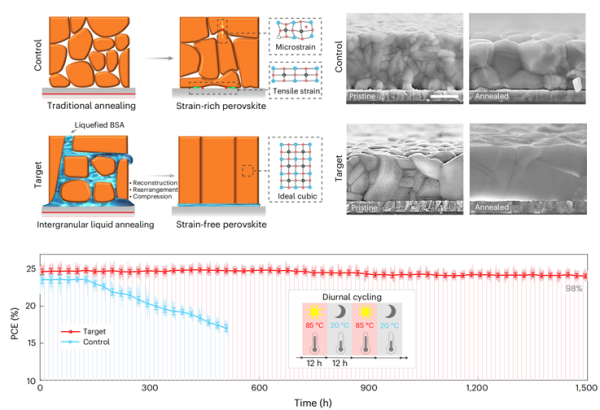
Residual stress is a common issue in perovskite thin films fabricated by conventional processes, significantly degrading device operational stability and posing a major barrier to the commercial application of perovskite photovoltaics. To address this challenge, the team innovatively leveraged the meltable nature of 1,4-butanesultam (BSA) during annealing to precisely regulate perovskite crystallization kinetics and compositional distribution, thereby effectively releasing residual stress accumulated during film growth. This work clarifies the critical role of strain regulation in enhancing the long-term stability of perovskite cells and provides a novel technical pathway for developing high-efficiency, long-lifetime perovskite photovoltaic devices. The related paper, titled “Additive-assisted liquid medium annealing relieving strains in perovskite solar cells for improved stability”, was published in Nature Energy.
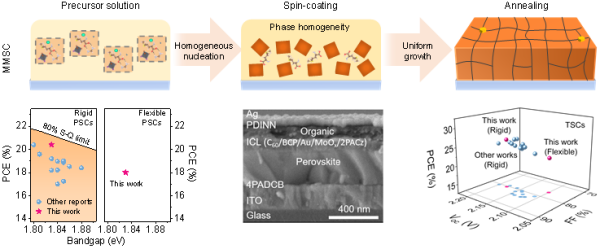
Flexible perovskite/organic tandem photovoltaic cells offer advantages such as low cost, high efficiency, lightweight, and thin form factors, holding broad application prospects in mobile energy supply, flexible wearable devices, and other fields. However, the wide-bandgap perovskite materials used in tandem devices are prone to phase heterogeneity during crystallization, which generates numerous defects and severely limits optoelectronic performance. To overcome this challenge, the team independently developed a multifunctional additive, DL-methionine methylsulfonium chloride (MMSC), to precisely regulate the crystallization process of wide-bandgap perovskites. This enabled uniform nucleation and high-quality film growth, effectively passivated crystal defects, and suppressed charge recombination and phase segregation. The related paper, titled “Crystallization modulation for wide-bandgap perovskites with universal defect passivation toward efficient perovskite/organic tandem photovoltaics”, was published in Nature Communications.
The consecutive publication of this series of high-level results fully demonstrates our university’s strong research capabilities and innovative edge in the field of perovskite photovoltaics. By tackling core challenges such as film strain, crystallization, and defects, the team has not only enriched the fundamental theories in related areas but also provided key technical support for the industrialization of perovskite photovoltaics. Looking ahead, the team will continue to deepen its efforts in new energy optoelectronics, striving for original and practical technologies to support the high-quality development of China’s photovoltaic industry.
Paper links:
1.Additive-assisted liquid medium annealing relieving strains in perovskite solar cells for improved stability, Nat. Energy, 2026, https://doi.org/10.1038/s41560-026-02072-z
2.Crystallization modulation for wide-bandgap perovskites with universal defect passivation toward efficient perovskite/organic tandem photovoltaics, Nat. Commun., 2026, https://doi.org/10.1038/s41467-025-68125-1
Written by: Bu Tongle, Huang Linglin
Rewritten by: Mei Mengqi
Edited by: Li Huihui, Li Tiantian
Source: State Key Laboratory of Advanced Technology for Materials Synthesis and Processing
|
|