
Recently, Professor Li Baowen’s team made significant progress in the field of ferroic-order control of sodium niobate. The related research findings were published in the international academic journal Nature Communications under the title “Room-temperature Ferroelectricity in NaNbO₃ Membrane”. Professor Li Baowen from WUT’s State Key Laboratory of Advanced Technology for Materials Synthesis and Processing, Professor Zhang Shujun from City University of Hong Kong, and Professor Guo Jinming from Hubei University are the co-corresponding authors. Doctoral student Wang Yunfan from the School of Materials Science and Engineering is the first author, with WUT as the first completing institution.
Sodium niobate (NaNbO₃), as a widely studied lead-free perovskite material, holds tremendous application potential in areas such as energy storage, electromechanical coupling, and the electrocaloric effect. However, NaNbO₃ has long been considered an antiferroelectric material at room temperature, and its application development has consistently been hindered by a key limitation: the inability to stabilize its ferroelectric phase at room temperature. Previously, all methods, including strain engineering in thin films, resulted in metastable or impurity phases, thus impeding a deep understanding of the ferroelectric properties of NaNbO₃ and its application potential.
To overcome this challenge, the research team innovatively proposed a topochemical conversion strategy for synthesis and successfully achieved the controllable preparation of high-quality, ferroelectric NaNbO₃ freestanding membranes. The membranes exhibit a thickness-dependent piezoelectric enhancement effect. Conductive atomic force microscopy (c-AFM) measurements show that the ferroelectric NaNbO₃ freestanding membranes also exhibit pronounced resistive switching behavior. Based on this, the research team fabricated NaNbO₃-based ferroelectric memory devices, opening new avenues for NaNbO₃ in the field of non-volatile memory.
This work not only challenges the conventional understanding that the ferroelectric phase of NaNbO₃ is difficult to stabilize at room temperature but also comprehensively demonstrates the ferroelectric properties and application potential of ferroelectric NaNbO₃ freestanding membranes, from synthetic innovation to mechanistic analysis and functional verification. Moreover, this synthesis strategy can be extended to other perovskite materials, providing a new pathway for the design and preparation of novel perovskite materials.
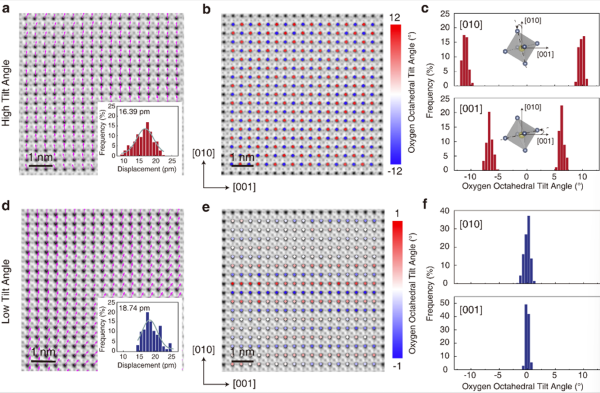
Atomic structure analysis of ferroelectric NaNbO3 freestanding film
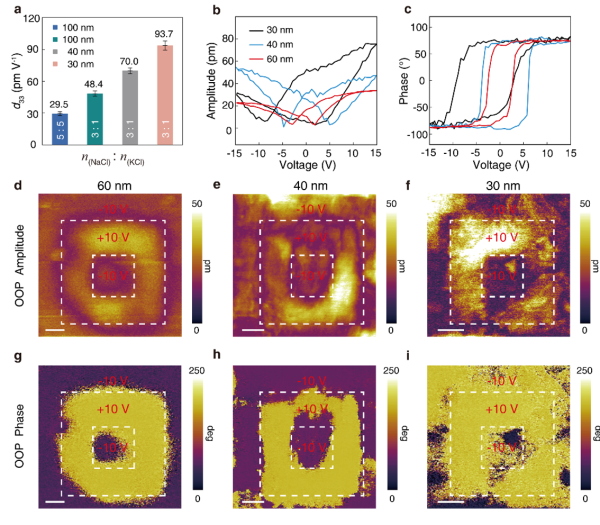
Analysis of piezoelectricity and ferroelectricity of ferroelectric NaNbO3 freestanding films
Paper link:https://www.nature.com/articles/s41467-026-74642-4
Written by: Li Baowen, Huang Linglin
Rewritten by: Xu Hanyue
Edited by: Li Huihui, Li Tiantian
Source: State Key Laboratory of Advanced Technology for Materials Synthesis and Processing
|
|