
Recently, the research team led by Academician Fu Zhengyi and Researcher Sang Xiahan from the State Key Laboratory of Advanced Technology for Materials Synthesis and Processing has made important progress in the field of solid-liquid phase transitions in confined spaces. The related research findings were published online on July 16 in the international academic journal Science under the title “Geometrically Driven Reversible Solid-Liquid Phase Transition at the Atomic Scale”.
In nature and materials synthesis, confined spaces that provide two or more surfaces represent an extremely common yet highly complex condition for heterogeneous nucleation, giving rise to a large number of anomalous phenomena that cannot be described by classical theories. For a long time, how to control and observe the phase transition process of critical nuclei at the nanometer scale in confined spaces, and thereby modify classical nucleation theory, has remained a tremendous challenge.
To address this challenge, the research team in situ constructed bismuth (Bi) clusters with radii below 5 nm inside a transmission electron microscope, and observed their phase transition process in real time in confined spaces. The study reveals that the core parameter determining this phase transition process is not the critical nucleation radius or critical nucleation volume as in classical theory, but rather the aspect ratio of the critical nucleus in the confined space. The transition from a single surface in classical heterogeneous nucleation to dual surfaces in confined spaces represents a fundamental transition that qualitatively changes the nucleation process, fundamentally altering the kinetics of the nucleation process. Analysis shows that within a large range of aspect ratios, nucleation in confined spaces even has no nucleation barrier, and the liquid-solid phase transition is extremely rapid. This constitutes a major revision to classical nucleation theory.
In addition, the geometric confinement effect forces nanowires to exhibit a strongly preferred growth orientation, whereas such preferred orientation is completely absent in unconfined nanoparticles. This achievement not only visually demonstrates the solid-liquid phase transition process under geometric confinement at atomic resolution, providing a mechanistic basis for geometry-driven phase selection and orientation selection, but also offers theoretical support for the design of novel nanomaterials through confinement engineering, interfacial regulation in composite materials, and bioinspired materials and bioinspired process synthesis.
WUT’s State Key Laboratory of Advanced Technology for Materials Synthesis and Processing is the first affiliation of the paper. Researcher Sang Xiahan and Researcher Ding Feng from Suzhou Laboratory are co-corresponding authors. Dr. Cui Wenjun, who graduated from WUT in 2024, is the first author of the paper, and Dr. Qian Cheng from Suzhou Laboratory is the co-first author. This work was supported by projects including the Ministry of Education Pilot Program, the National Natural Science Foundation of China, and the National Key Research and Development Program of the Ministry of Science and Technology.
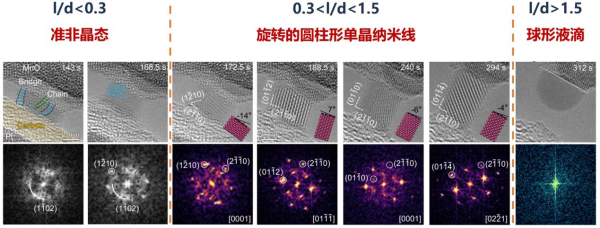
Reversible phase transition process of Bi with varying aspect ratios in confined spaces.
Paper link: https://science.org/doi/10.1126/science.aed6019
Written by: Sang Xiahan
Rewritten by: Xu Hanyue, Lin Qiaochu
Edited by: Li Huihui, Li Tiantian
Source: Institute of New Materials(State Key Laboratory of Advanced Technology For Materials Synthesis and Processing)
|
|