
Recently, the research team of Professor Mu Shichun from the State Key Laboratory of Advanced Technology for Materials Synthesis and Processing published an original research paper titled “Curvature-Directed Electrochemical Reactivity on Topological Carbon” in Matter, a a Cell Press journal. Wuhan University of Technology (WUT) is the lead institution for the study. Doctoral students Gong Lei, Chen Ding, and Zhao Hongyu are co-first authors, and Professor Mu Shichun and Dr. Yu Ruohan are corresponding authors.
Professor Mu’s team innovatively adopted a molten salt-assiste strategy to successfully prepare high-curvature carbon materials with abundant pentagonal topological defects, achieving precise control over the geometric curvature of these topological defects. By integrating advanced experimental characterization and theoretical calculations, including three-dimensional electron tomography, two-dimensional STEM curvature quantitative analysis, finite element simulation, and first-principles calculations—the team revealed for the first time that geometric curvature induces an enhanced localized electric field on the surface of topological defect carbon. This electric field promotes rapid desorption of OH⁻ intermediates during the oxygen reduction reaction (ORR), effectively preventing active site poisoning and thereby significantly improving the intrinsic catalytic activity and stability of topological defect carbon. Based on these findings, they proposed a new structure–activity relationship of “geometric curvature-localized electric field-catalytic activity”. Moreover, geometric curvature also plays a crucial role in electrochemical energy storage; high-curvature topological defect carbon exhibits excellent electric double-layer capacitance performance, further demonstrating the broad application potential of curvature engineering in energy conversion and storage. This research breaks through the traditional design approach that primarily relies on heteroatom doping or topological defect concentration to enhance carbon performance, and proposes for the first time the novel concept of “topological defect curvature engineering” as a carbon material design strategy. This work provides a new theoretical basis for the rational design of high-performance functional carbon materials and opens up new research directions for the development of curvature-tunable functional materials.
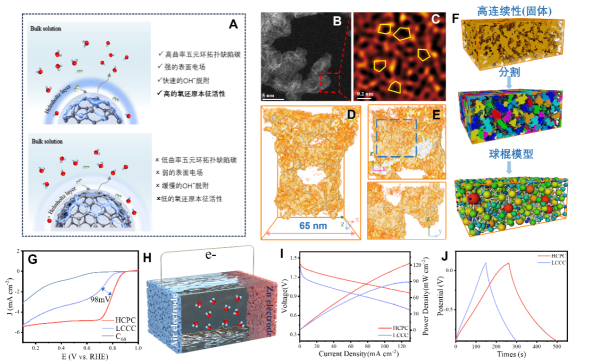
A) Schematic illustration of the mechanism by which high-curvature pentagon carbon (HCPC) enhances localized electric fields and promotes ORR; B-C) HAADF-STEM images of HCPC; D-F) Three-dimensional reconstruction images of HCPC; G) ORR performance of HCPC; H) Schematic of a zinc–air battery; I) Zinc–air battery performance; J) Specific capacitance performance.
Professor Mu Shichun's team has long been dedicated to research on topological defect carbon materials and their energy catalysis applications, conducting in-depth studies on the construction, electronic structure regulation, and catalytic mechanisms of topological defect carbon. Recently, the team systematically summarized the development history, controllable preparation strategies, advanced characterization methods, catalytic mechanisms, and energy conversion applications of topological defect carbon materials, comprehensively establishing a research framework for this field and providing important theoretical guidance for future development (Prog. Mater. Sci. 2026, 157, 101618). This original research published in Matter further elucidates the curvature-regulation mechanism of the intrinsic activity of topological defect carbon, and the proposed new concept of "atomic curvature engineering" lays a solid theoretical foundation for the research and development of topological defect carbon materials.
Paper link: https://doi.org/10.1016/j.matt.2026.102958
Written by: Gong Lei, Huang Linglin
Rewritten by: Xu Hanyue
Edited by: Li Huihui, Li Tiantian
Source: Institute of New Materials (State Key Laboratory of Advanced Technology For Materials Synthesis and Processing)
|
|