
Recently, Professor Xia Mengling of Wuhan University of Technology (WUT) has made new progress in the field of dangling-bond-free scintillator research. The related findings, titled “Dangling-bond-free, chemically anisotropic semiconductors for ultrahigh-resolution X-ray imaging”, were published in Nature Photonics (IF=38). The State Key Laboratory of Silicate Materials for Architectures and the School of Materials Science and Engineering of WUT serve as the primary corresponding affiliations, with Hubei Longzhong Laboratory and Huazhong University of Science and Technology the co-corresponding institutions. Liu Jiaqi, a doctoral student, is the sole first author of the paper, while Professor Xia Mengling and Professor Niu Guangda of Huazhong University of Science and Technology are the co-corresponding authors.
Traditional semiconductor materials are prone to dangling bonds and defect states at surfaces, interfaces, and grain boundaries, thereby affecting carrier transport and photoelectric conversion performance. To address this issue, the research team proposed a new approach of "decoupling electronic structure from crystal structure": by combining a zero-dimensional electronic structure with anisotropic chemical bonding, they achieved directed growth of the material on a macroscopic scale while maintaining the intrinsic dangling-bond-free property, thereby balancing low-defect characteristics with tunable material morphology.
The research team used uranyl halide semiconductors as a model material and found that their unique zero-dimensional electronic structure endows the material with pronounced morphology-insensitive luminescence. Whether the material is in single-crystal, powder, or polycrystalline thin-film form, its photoluminescence quantum yield remains above 90%. At the same time, the material exhibits excellent environmental stability and irradiation stability, maintaining stable luminescence performance under high-humidity conditions and continuous X-ray irradiation, and achieving a spatial resolution of 34 lp mm⁻¹ in X-ray imaging.
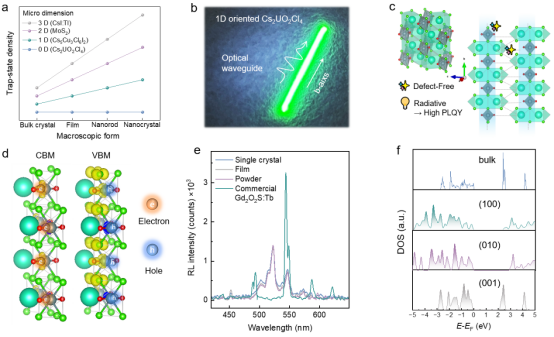
This study shows that the material can effectively avoid the performance degradation of traditional scintillator materials caused by increased surface and grain-boundary defects when processed into powders, thin films, or polycrystalline forms. This research not only provides a new solution for the development of high-performance X-ray detection materials, but also offers new ideas for the material design of novel semiconductor devices such as light-emitting diodes, photodetectors, and field-effect transistors.
Professor Xia Mengling's research group focuses on ultrafast scintillators and X-ray flat-panel detection and has achieved a series of innovative results in recent years (Nat. Commun. 2026, 17, 820; ACS Energy Lett. 2026, 11, 4837; Adv. Funct. Mater. 2026, e78086; Adv. Funct. Mater. 2026, e19193; Angew. Chem. Int. Ed. 2025, 137, e202425448; Adv. Mater. 2024, 2313663; Adv. Mater. 2023, 2211769, etc.).
Paper link: https://www.nature.com/articles/s41566-026-02013-y
Written by: Liu Jiaqi
Rewritten by: Xu Hanyue
Edited by:Li Huihui, Yu Bingjie
Source: School of Materials Science and Engineering
|
|